 Taigi Dictionary
Look it up,
and learn it
DictionaryOpen it and search. No network, no account, with spoken audio and camera lookup.
LearnThe 700 common characters — the Ministry’s writing standard for certification — ten a session, 70 days.
Free to download. Pro and Study are one-time purchases.
iPhone · iPad · Mac · Apple Vision Pro
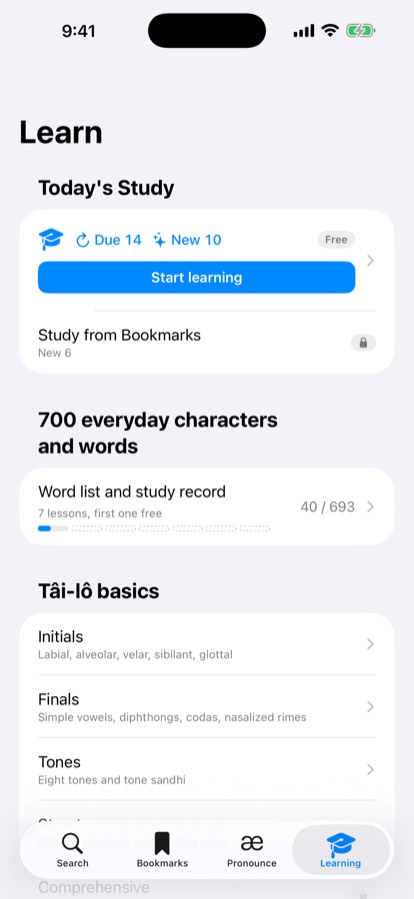
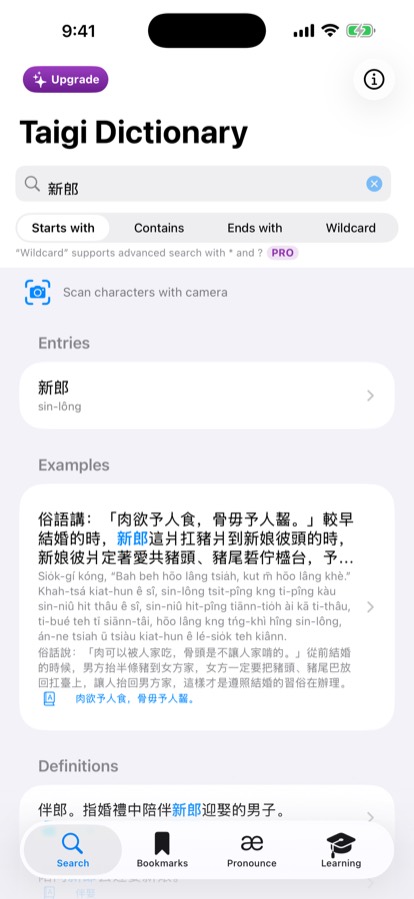
LearnAll 700 common characters, ten a session, 70 days
Start from “Today” and the app asks each character back at the interval that suits it. Reading, writing and listening are tracked separately, and every sound is a human recording.
5 units
Initials, rimes, tones, syllable structure and a mixed drill — listening and tone sandhi covered
Ready the moment you install the app
700 characters
Ten a session, one full pass in 70 days. The first hundred or so are free
The rest, and the dictation drill, open with Study
LearnThe only thing to decide is whether to open it
Review right before you forget
The app decides how many questions you get today and which word comes next — you just answer. Recall a word after a 90-day gap and it graduates.
Drill your weakest skill
Hanji to meaning, sound to meaning, meaning to Hanji, dictation: 7 skills scored independently and asked in 11 formats. If you can read a word but not write it, writing questions come up more.
Build your own deck
Words you bookmark in the dictionary become a deck of their own (Study). Learn the words you actually want to learn.
Examples and audio straight from the dictionary
Every gloss, example and recording comes from the bundled Ministry of Education dictionary. Nothing is written for the course, and no voice is synthesized.
Before installing, try today’s 10 in the browser — a new set each day, no records kept.
DictionaryFour dictionaries, included verbatim
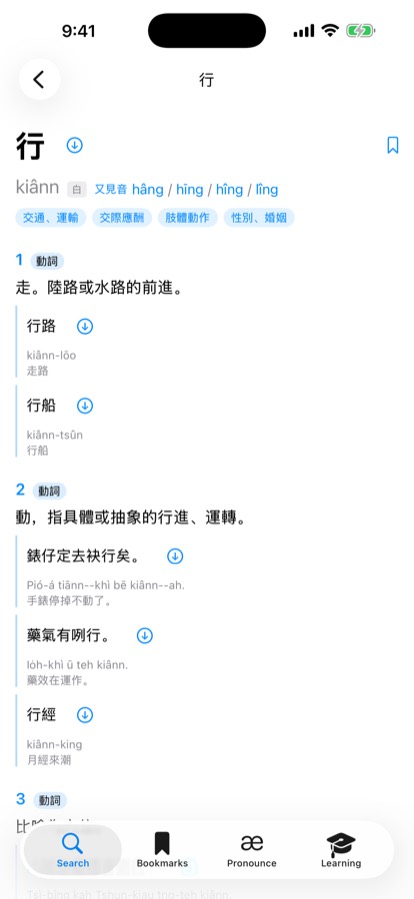
The Ministry of Education dictionary comes first; three supplements take over only when it has no match. Never rewritten, never merged, and every entry shows where it came from.
29,591 headwords
23,298 senses · 17,907 examples · all audio
CC BY-ND 3.0 TW · included as-is
5,826 entries
Subject terms from school materials, with Mandarin glosses
MoE open data declaration
2,157 entries
Modern and newly coined words settled by an expert panel
CC BY 4.0 · PTS Taigi
64,920 headwords
43,131 of them absent from the Ministry’s dictionary
CC BY-SA 4.0 · Tēⁿ Liông-úi, Iûⁿ Ún-giân
DictionaryNo network, no account
Install it once, then work offline
All four dictionaries and the category index ship inside the app. Entries appear in Hanji and Tâi-lô, and you can search in Tâi-lô, POJ or numeric tones.
Play the Ministry’s own recordings
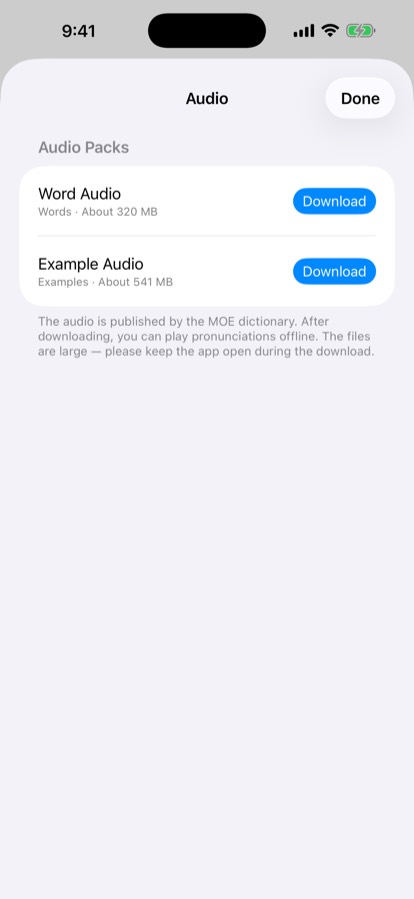
Original audio for both headwords and example sentences, including accent differences from 10 regions.
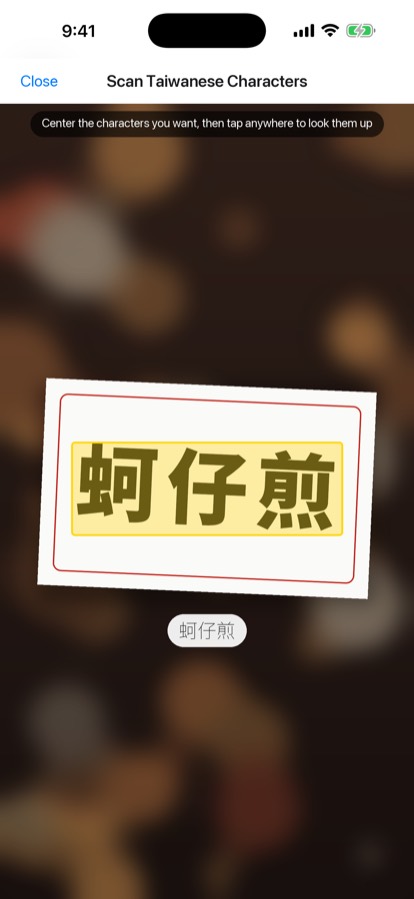
Point the camera at a character you can’t read
The app segments the text against the dictionary and highlights what it can look up. Tap one to open its entry.
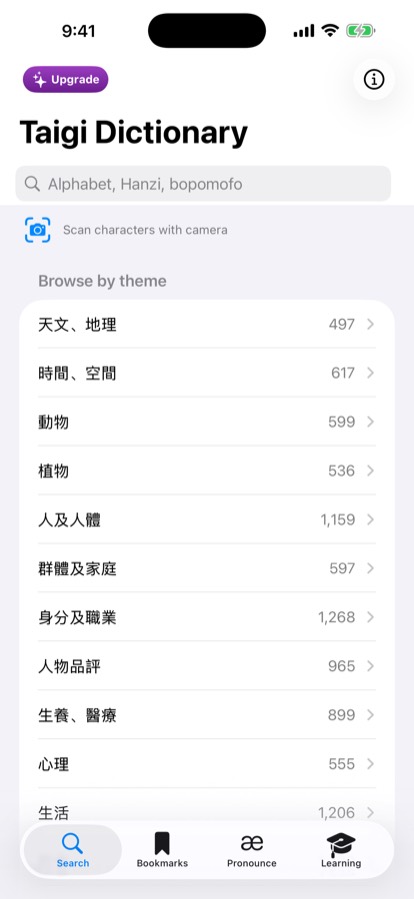
Browse 23 categories, come back through bookmarks
The Ministry’s index goes down to 103 subcategories. Lookups are saved automatically, and a “word of the day” widget sits on your Home Screen.
Screens
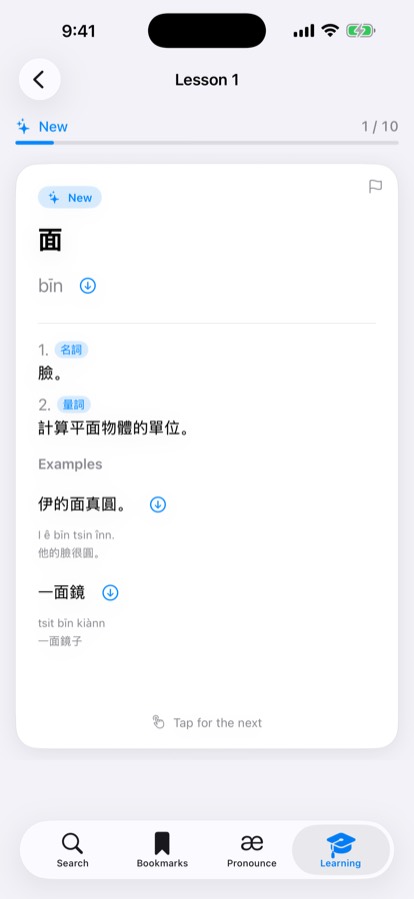
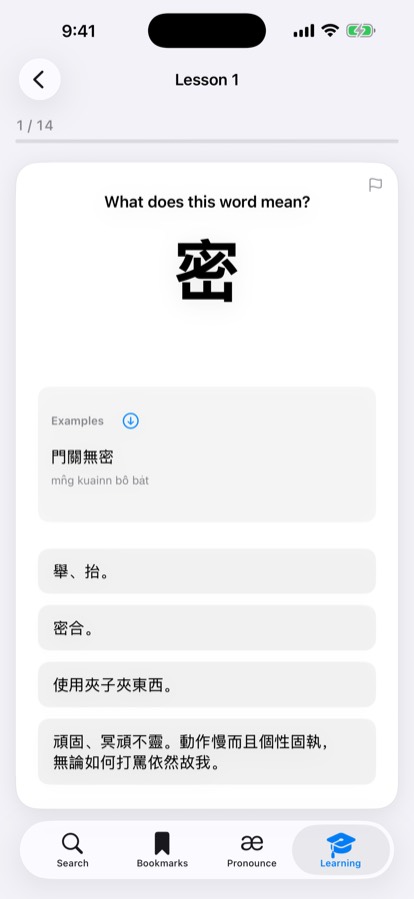
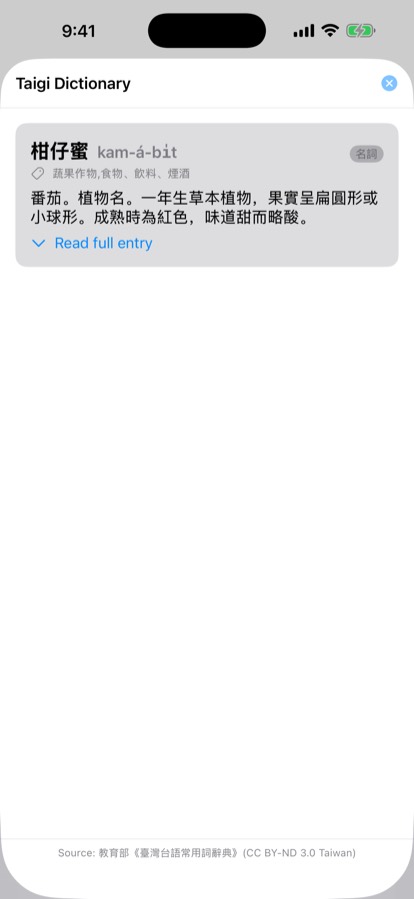
One-time purchases, yours forever
The dictionary text and audio, along with the Tâi-lô basics and lesson 1, stay free forever. Two one-time purchases, both shared across every device on the same Apple ID. The 7-day trial reverts to the free version on its own — nothing is charged automatically.
- 🧭 Look up anywhereSelect text in any app to search the dictionary and hear the pronunciation.
- 📷 Unlimited camera lookupsThe free version gives a few scans a day; Pro removes the limit.
- ✳️ Wildcard searchUse * and ? when you can’t recall how a word is written.
- 🧩 Advanced widgetsExtras like a bookmarks carousel on your Home Screen.
Frequently asked questions
Does it work without an internet connection?
Yes. Once installed, the dictionary text, all three supplementary dictionaries, the category index and every audio file live on the device. Looking a word up, hearing it and doing the lessons all work offline, and there is no account or sign-in.
Is it free? What does it cost?
The download is free. The dictionary text and audio, the five Tâi-lô foundation units and the first lesson of the 700 common characters stay free forever. Taigi Pro and Taigi Study are one-time purchases, not subscriptions; the 7-day free trial drops back to the free version when it ends and never bills you automatically. Both are shared across devices on the same Apple ID.
Which dictionaries are included?
The main one is the Ministry of Education's Dictionary of Frequently-Used Taiwanese Taigi: 29,591 entries, 23,298 senses, 17,907 example sentences and all of its audio, included as-is. When a search finds nothing, three supplementary dictionaries take over — 5,826 entries from the MoE's Taigi glossary of school subject terms, 2,157 from PTS Taigi's dictionary of new words, and 64,920 from the Taiwanese-Mandarin Online Dictionary, 43,131 of which the MoE dictionary does not carry. Nothing is rewritten or merged, and every entry names its source.
Can I search in Tâi-lô or Pe̍h-ōe-jī (POJ)?
Tâi-lô, Pe̍h-ōe-jī (POJ) and numbered tones all work, and Pro adds * and ? wildcard search. For Han characters you cannot read, point the camera at them: the app segments the text against the dictionary and opens the entry.
Is the audio recorded by speakers or synthesised?
All of it is the original recording from the MoE dictionary. Words and example sentences both have audio, and accent variation from 10 regions is included. The definitions, examples and audio used in the lessons come from the same dictionary — no sentences are written for the app, and no synthetic speech is used.
How long does it take to finish the 700 common characters?
The 700 characters the Ministry publishes as the writing standard for Taiwanese certification are taught ten a session, one full pass in 70 days. Seven aspects — character to meaning, sound to meaning, meaning to character, dictation and more — are scored separately across 11 question formats. The app picks which character comes next and when to review it, so the only thing you decide is whether to sit down today. A character that you still remember 90 days later graduates.
Which devices does it run on, and can I try it before installing?
It runs on iPhone, iPad, Mac and Apple Vision Pro. To try it you do not need to install anything: Bee 台語 gives you ten questions a day in the browser, free and without an account.